AIDAQ 2026 Day 2: From readiness to real-world impact
While Day 1 asked how Europe can turn technological change into economic and societal progress, Day 2 of #AIDAQ26 moved closer to the “how”: from AI adoption to measurable value, from technological sovereignty to industrial capability, and from promising technologies to what it takes to scale them.
At the AI, Data & Quantum Summit 2026, more than 2,500 participants came together across two days, alongside more than 200 speakers and 140 sessions. And the exchange reached far beyond the stages – into workshops, side meetings, the exhibition and countless conversations throughout bcc Berlin.
Day 2 opened with a bold question: “AI Everywhere, Impact Nowhere. What Now?” For Kenza Ait Si Abbou, Founder & CEO of scailers, the gap between using AI and creating value from it is not simply a technology challenge. It is also about leadership, readiness and organisational change. “AI adoption is a marathon, not a sprint,” she said. And: “Uncertainty is not the opposite of readiness; it is often the starting point of responsible change.”
That shift from adoption to impact ran through many of the conversations on Day 2.
Sarah Engel, Head of AI at TRUMPF, explored what it takes to scale AI for industrial competitiveness. Dr Denise Holtschulte, VP Strategy & Transformation at Capgemini Invent, put it in a nutshell: “Without context, AI generates. With context, AI decides. With redesigned work, AI creates value.”
At Taxfix, that transformation is already taking shape. CEO Martin Ott shared that automation has reduced handling time in tax preparation by 70 percent – while stressing that trust remains fundamental when technology meets financial decisions.
The question of control and choice remained equally central. Lars Neumann, Senior Vice President T Cloud, framed European sovereignty not as doing everything ourselves, but as retaining “the freedom of choice”.
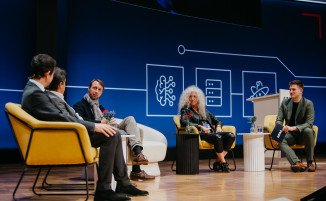
That perspective continued in the panel “How Europe Builds, Adopts and Scales Critical Technologies”, where Pierre Chastanet, Michael Kollig, Clemens Utschig-Utschig and Dr Kristel Michielsen explored what Europe needs to move critical technologies from capability to adoption and scale.
Day 2 also took the conversation beyond software.
The panel on Robotics and Physical AI brought Europe’s industrial strengths into focus – alongside the need to connect academia, industry and startups, experiment more and translate technological capabilities into reliable real-world systems.
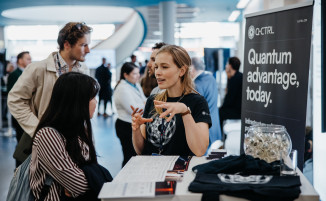
Quantum, too, continued its move towards application and value, with discussions ranging from integration and security to hybrid approaches and concrete use cases.
Another Day 2 highlight was the Deep Tech Pitch by Get Started by Bitkom. Four startups took to the Main Stage to present their innovations to the jury – with yasp taking the win. Congratulations to Stefan Krassin and the entire yasp team!
These are just some of the perspectives that shaped a much broader second day of #AIDAQ26. Across AI, data and quantum, one theme connected many of them: technology creates impact when it is adopted, governed, integrated and scaled.
After two days of keynotes, panels, deep dives, workshops, pitches, meetings and exchange, AIDAQ 2026 leaves Berlin with new connections, fresh perspectives and conversations ready to travel far beyond the summit.
And because the most valuable conversations should not end when the stages go quiet, follow AIDAQ on LinkedIn and become part of the AIDAQ community – carry the ideas and perspectives from Berlin forward, bring new voices into the dialogue and keep the conversation around AI, data and quantum moving.
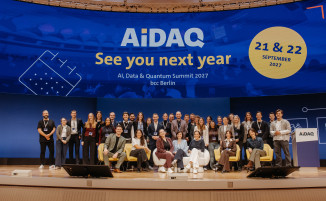
We look forward to next year’s edition of AIDAQ on 21 and 22 September 2027!