Become
a speaker
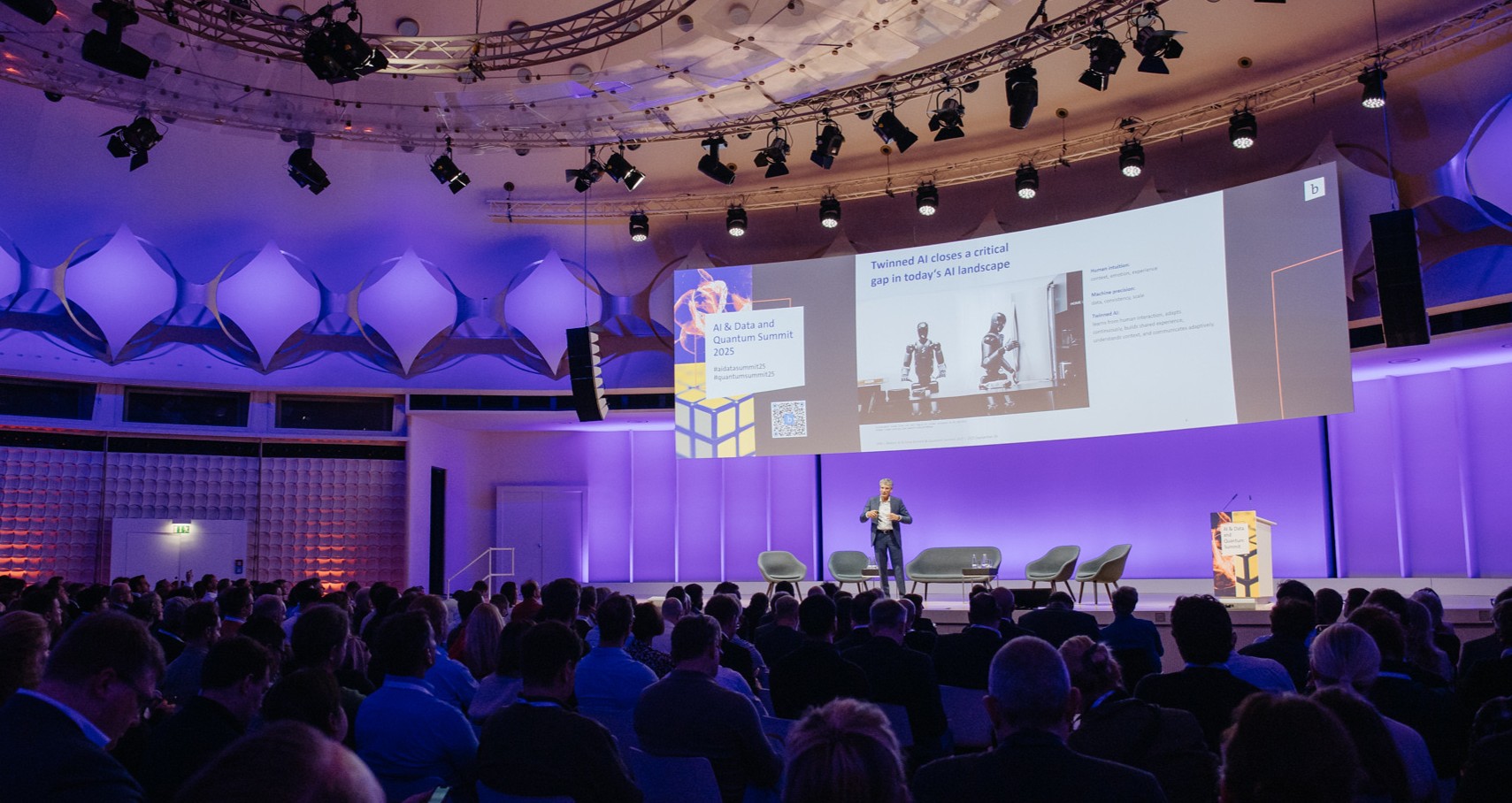
With the AI, Data and Quantum Summit (AIDAQ), we aim to connect technology providers with user industries and decision-makers, combining strategic perspectives with applied and expert-level discussions.
We invite experts and practitioners to submit contributions on both industry applications and technology frontiers of Artificial Intelligence and Quantum Computing, spanning vertical use cases as well as horizontal enablers across the stack. Relevant contributions include lessons learned from pilot programs to scalable deployment, along with advancements that enable commercialisation and industrialisation, such as architectures, software, infrastructure integration, performance, reliability, benchmarking, and validation.
For use-case and deployment-focused talks, we prioritise actionable insights and real-world impact with a profound technological depth. We therefore especially welcome submissions from:
- Technology providers presenting jointly with a customer or implementation partner
- Business or Institutional end-users sharing deployment experiences.
Topics
Proposals may cover one of the following topics (but are not limited to these):
Industry Application & Adoption (AI & Quantum)
- Use cases, pilots and lessons learned across key sectors with a particular focus on automotive & mobility, finance, health & life sciences, and manufacturing
- Progress from PoCs towards real-world deployment and industrial relevance
- Cross-cutting AI × Quantum opportunities and constraints in practice
- Organisational and operational readiness: skills, roles, sourcing, partnerships
Benchmarking, Metrics & Evaluation (AI & Quantum)
- AI: model evaluation and benchmarking (quality, robustness, safety), compute/data efficiency, lifecycle KPIs
- Quantum: benchmarking and validation of systems/workloads, comparability metrics, resource estimation & feasibility
- Evaluation methodologies, standards, and decision-relevant evidence
Quantum Stack & Systems Progress
- End-to-end progress across hardware, control, software toolchains and algorithms
- System engineering bottlenecks, reliability constraints and integration challenges
- Scaling pathways: error mitigation, error correction and fault tolerance
- Architectural trade-offs, milestones and performance indicators
Hybrid Quantum Integration (Quantum–HPC–Classical)
- Hybrid workflows, orchestration and runtime integration
- Integration of Quantum Computing into existing HPC, cloud and IT environments
- Toolchains, interfaces, compilers/runtimes and workflow design
- Data movement, latency, operational constraints and deployment models
Quantum Security & Quantum-Safe Infrastructure
- Post-quantum cryptography migration: timelines, approaches and readiness
- Quantum security implications for organisations and critical infrastructure
- Quantum communication where relevant to security and infrastructure
AI Systems, Data & MLOps
- Foundation models, applied AI, agentic and multimodal systems
- Data products and spaces, governance, quality, data sharing and interoperability
- AI-assisted and AI-native development workflows (vibe coding, agentic coding, etc.)
- AI infrastructure and compute architectures (energy, efficiency, scaling, etc.)
- MLOps and lifecycle management: monitoring, drift, evaluation, reliability
Trustworthy AI, Compliance & Secure AI Engineering
- Governance and compliance operationalisation (incl. AI Act)
- Risk management, documentation, auditing and accountability
- Secure AI engineering: robustness, adversarial threats, security-by-design
- Responsible deployment in regulated and high-stakes contexts
Submission Process
Submissions Deadline: Tuesday, 31 March 2026 at midnight (12:00 AM Berlin time, Standard Time Zone: GMT/UTC + 01:00 hour).
All abstracts and presentations must be submitted and delivered in English. Our council of experts will assess all submissions for quality and relevance, especially regarding their contribution to commercialization, industrial adoption and scaling. Final decisions will be made by Bitkom and communicated via email by the end of April.
PLEASE ADHERE TO THE ABSTRACT SUBMISSION GUIDELINES